Tuesday, November 8, 2022

Audio Series: Side Effects of Wanting


Our audio series "The Authors Read. We Listen."  was originally hatched in a NYC club during BEA back in 2012. It's a fun little series, where authors record themselves reading an excerpt from their own novels, in their own voices, the way their stories were meant to be heard.


Today, 
Mary Salisbury will be reading an excerpt from her story collection Side Effects of Wanting. Her short fiction and essays have been published in Fiction SoutheastWhitefish ReviewFlash Fiction MagazineCutthroat: A Journal of the Arts, and Cutthroat’s Truth to Power. Her chapbooks, Come What May and Scarlet Rain Boots, were published by Finishing Line Press, and her poetry has appeared in Calyx: A Journal of Art and Literature by WomenSpry Literary Journal, and Wild Roof Journal, and is forthcoming in The MacGuffin and Michigan Quarterly Review. Salisbury is an Oregon Literary Arts Fellowship recipient and a graduate of Pacific University’s MFA in writing program. She lives in Portland, Oregon.


Click on the soundbar below to hear Mary from her collection: 


In Side Effects of Wanting, author Mary Salisbury gathered together the pieces of humanity she saw reflected in the lives around her and distilled them into a poetically written, beautifully curated short story collection. In this debut, small-town stories speak of love and belonging, longing and regret. The people who populate these tales yearn for companionship and comfort—but all too often they must, instead, face the trauma of fractured relationships and the ache of not quite becoming the person they hoped to be.


Saturday, November 5, 2022

Books I Read in October

 Halloween has come and gone and Christmas is like a blink away... where the heck did this year go?

I appear to have kept up a pretty healthy pace this past month, reading a total of 8 books in October! In case you were curious, here's a peek at which ones they were:


River Woman, River Demon by Jennifer Givhan

Oh yaaaas, this book hit the spot!

As the anniversary of her best friend's drowning approaches, the frequency of Eva's blackouts increase, a residual side effect from the trauma she experienced as a teenager all those years ago. Then one evening, Eva awakens on the couch to the sound of her husband Jericho moaning for help down by the river behind their home, and upon reaching its muddy bank, she finds him clutching the dead body of their best friend Cecelia. The cops show up and arrest Jericho, and Eva is left trying to pull together the pieces of what the hell just happened.

A chicana bruja and curandera, Eva searches for the truth through unusual means, calling upon the ghosts of the drowned women who haunt her and leveraging her ancestrial magick skills to keep herself and her family safe.

A gorgeously written novel that mixes the magical with the paranormal, River Women, River Demon is a haunting look at the power of our pasts and the achingly familiar desire to not lose faith when all the evidence screams otherwise.


The Animals in That Country by Laura Jean McKay

One of the best books I've read this year and it's crazy to think that it would have slithered right under my radar if I hadn't happened across a blogger's review of it when I was reaching out to them to pitch a client's book.

I'm also shocked at how many people are either on the fence about it or flat out disliked it. It's so friggen good you guys! How can anyone not like it?!

It kicks off in a zoo, where we spend time with Jean, one of the zoo's guides, her daughter-in-law Ange, who runs the zoo, and her granddaughter Kim, at the very start of a highly transmittable virus that quickly escalates to pandemic status. Not long after the initial flu-like symptoms wear off, the infected begin communicating with animals - first, they can hear the mammals. Next, the birds. And there are some, god help them when they reach this stage, who can hear the insects.

Initially thought to have gone mad, many of them kill their pets, or release them from captivity. Ange gets word that all zoos and sanctuaries are to be placed on lockdown, and so lock down they do. Jean and Kim used to play a game where they'd guess what the animals were thinking, and to them, this "zooflu" sounds like a dream. Imagine what that could be like... speaking to the animals. Breaking that barrier and truly understanding their thoughts. It's especially enticing to Jean, who has bonded greatly to a female dingo named Sue that she rescued as a pup. So when her infected estranged son Lee shows up at the gates, she embraces the opportunity to let him inside.

As the exposure sets in amongst the staff, Lee takes off with Kim towards the ocean where he plans to commune with the whales, and Jean, now starting to show signs of the illness, hits the road with Sue. What follows is a hallucinatory and heart wrenching journey to reclaim her family and maintain her humanhood in a world in which the animals now appear to have the upper hand.


Daphne by Josh Malerman

I don't know why I keep reading new Malerman books expecting them to blow me away the way Birdbox did. They just don't. And it's not a dig on his writing or the stories he's telling. But my god, nothing will ever come CLOSE to that book, imo. I think they all suffer from never-gonna-beat-the-first-book-I-read-from-the-author syndrome. (ahem, if you know, you KNOW).

His other books are hit-or-miss with me... it's the most bizarre thing. Some (Black Mad Wheel; Unbury Carol; Goblin) were incredibly underwhelming. Others (Pearl; A House at the Bottom of the Lake; Malorie) were pretty ok. We can add Daphne to the pretty ok pile.

I listened to the audio and thought it was really well done. In it, we meet a group of high school female basketball players who are being brutally killed off, one by one, by what the girls believe is the ghost of Daphne, a small town urband legend that allegedly stalks those who summon her by simply THINKING about her...


They Were Here Before Us by Eric LaRocca

I thoroughly enjoy Eric LaRocca's writing. His books are deliciously bingeable and shamelessly cringey. He takes body horror to a totally different place and his latest book, They Were Here Before Us, continues that fabulous trend.

In this thematically connected collection of short stories, we're treated to a variety of perspectives - we're a beetle in a decomposing corpse, a chimpanzee who has lost his human lover, a bird tormented by a young child, a married couple who struggle at the hands of dementia... it's nature vs nurture at its wildest and it's really friggen good.

I'm sure I'm preaching to the choir here, because you've all ready something of his by now, right? Right?!? If not, well jesus, what are you waiting for?!?!


Dark Harvest by Norman Partidge

A dark town with a dark secret and a really strange tradition of turning their teenaged sons lose on halloween night in a hunt-or-be-hunted race to midnight.

Picked up this hokey halloween book for funsies, not really expecting a whole lot from it and this hit the spot ... when you take it face value. Which I kind of can't. There was very little set up and almost no backstory and gosh I have so many questions!! Like, why do they lock their sons in their rooms and starve them in the five days leading up to the "run"? Why is it that only the sons participate, and not the daughters? How did this horrible tradition begin and why do they have to keep satisfying it year after year? And why can't the locals leave?

While it created more questions than it seemed to answer, I sure am glad I'm not being stalked by a machette carrying pumpkin-vine-crow stuffed with loads of delicious candy. That's all I'm saying.


Empire of Wild by Cherie Dimaline

I hadn't heard anything about this book when I stumbled across it while browsing in a bookshop, and was pleasantly surprised by it. The jacket copy definitely does not do it justice.

I picked it up thinking it was a going to be a mild native thriller about a woman who went searching for her missing husband but it turned out to be so much more than that. It's steeped in canadian native culture and forklore, incredibly atmospheric, and took a fabulous turn into 'horror-adjacent' territory.

If you're looking for a slow burn with some teeth to it, Empire of Wild should be on your to-read list!

Very glad I found this one!


Man Fuck This House by Brian Asman

It looks like people were somewhat split on this one, but I found it to be a really fun read. One that I could have finished in one sitting if I hadn't started it so late the other night.

It's a quirky horror read - strange, not quite scary - that plays on the haunted house trope. A family moves into their dream home but things are not what they seem.

The wife, Sabrina, begins to see and hear things that she cannot easily explain and, like most normal people in weird situations, attempts to rationalize them away until she can't - a strange man appears on her basement steps and carries a box of her husand's sports stuff down into the basement then disappears into the crawl space; she heads upstairs to run a hot bath only to find someone has already done it though she's the only one home; she turns on the TV and sees herself in every show... Unfortunately, she's the only one experiencing it and her family is starting to think she's mentally unravelling. By the time her kids start to catch on to the fact that something is not quite right, they may be just a little too late...

I think the less you know going in, the better off you are, because it's an interesting spin on the genre. If you pick it up, I'd love to know what you think!!


The Passenger by Cormac McCarthy

I am not sure how I feel about this one.

Taking it at face value, it was a good book. I enjoyed listening to it. I could listen to MacLeod Andrews read just about anything. I liked the rough grit of it. I liked the dual narrative - bouncing between Bobby Western's weird antics, after he works a salvage dive at the site of a crashed plane, and the inside of what we learn to be his deceased sister's schizophrenic mind.

But it just didn't feeeeeel like a Cormac McCarthy book. It felt more like... well... I'm not sure what it felt like exactly but it did not feel like him.

Is that weird? Am I alone in this?


Have you read any of these? What did you think? 

Wednesday, November 2, 2022

Where Writers Write: Christopher Locke


 Welcome to another installment of TNBBC's Where Writers Write!


Where Writers Write is a series in which authors showcase their writing spaces using short form essay, photos, and/or video. As a lover of books and all of the hard work that goes into creating them, I thought it would be fun to see where the authors roll up their sleeves and make the magic happen. 


This is Christopher Locke. 

Christopher Locke was born in New Hampshire and received his MFA from Goddard College. His essays and short fiction have appeared in The North American Review, The Sun, The Rumpus, Slice, JMWW, SmokeLong Quarterly, Barrelhouse, and Atticus Review, among others. He won the Dorothy Sargent Rosenberg Poetry Award, as well as grants in poetry from the Massachusetts Cultural Council and the New Hampshire State Council on the Arts. 25 Trumbulls Road, his first collection of fiction, won the Black River Chapbook Award. His latest collection of poetry Music For Ghosts (NYQ Books) was released in 2022. His memoir-in-essays, Without Saints, is due out from Black Lawrence Press in October 2022. Chris lives in the Adirondacks and teaches English at SUNY Plattsburgh and North Country Community College.


Where Christopher Locke Writes


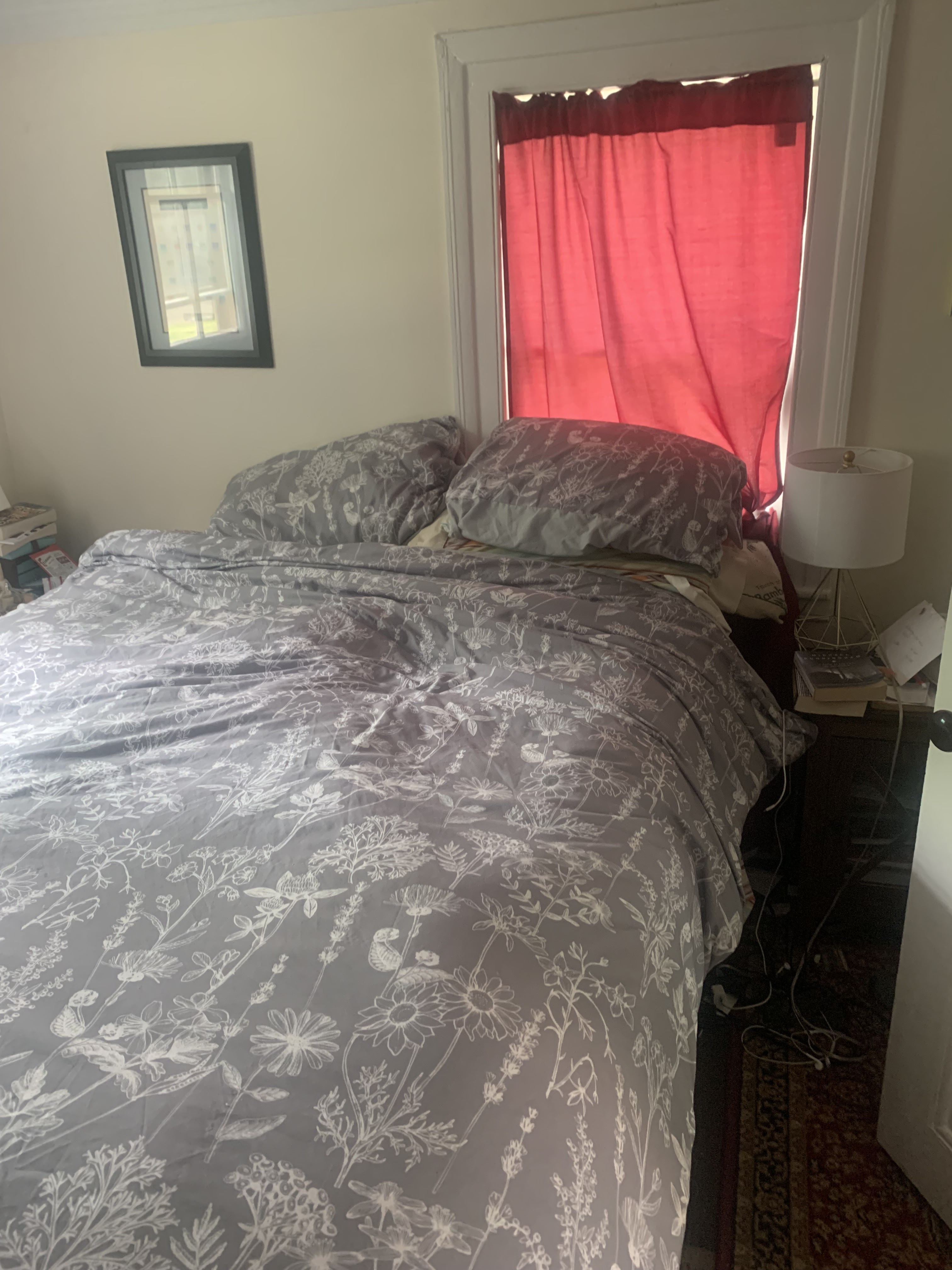
I like to write in bed. I’m not sure how this all came to be, because in my 20’s and 30’s, I’m pretty sure most of my writing was executed upright at a pine desk. Back then, I had this big-ass Brother hybrid (part typewriter, part tugboat engine component) so it didn’t necessarily lend itself to being plopped down on my stomach, squeezing the life out of me as I banged out a litany of woeful poems, (I was filled with a lot of woe in those days).


I think I love to write in bed because I also write best in the morning, when my head is clear and untroubled by anxiety, and bed provides a natural extension to the process. I really enjoy that whole stretching out business, the elongation of it all. Propped up on several pillows while I am telling a story is not only comfortable, but frankly, humane; I’m not one of those writerly types who says they compose best at 2:00 am whilst a windstorm rages outside and I reach for another jigger of whiskey.  


Savages.


And damnit, if it was good enough for Wordsworth, Proust, and Edith Wharton, it’s good enough for me!


Friday, October 21, 2022

Page 69: Josh Dale's The Light to Never Be Snuffed

 Disclaimer: The Page 69 Test is not mine. It has been around since 2007, asking authors to compare page 69 against the meat of the actual story it is a part of. I loved the whole idea of it and so I'm stealing it specifically to showcase small press titles - novels, novellas, short story collections, the works! So until the founder of The Page 69 Test calls a cease and desist, let's do this thing....


In this installment of Page 69, 
we put  Josh Dale's The Light to Never Be Snuffed to the test


OK, Josh, set up page 69 for us.

First of all, nice. Wanted to get that out of the way.

So, yeah, page 69 is actually a strong point in both the plot and character arc of Jack Grand, the protagonist & narrator. 

It’s the first day of 3rd grade, the first time ever in a grade school classroom, he gets humiliated in front of the class…and he gets into a fight with another boy. 

It’s crude, a bit bloody, and sets up Jack for a scolding immediately after. 

Jack says a bad word right at the end of page 68, so you got lucky.


What The Light to Never Be Snuffed is about:

 This novella is about a broken family on the cusp of divorce and foreclosure. All told through the eyes of a battered, and plausibly mentally unwell, young boy. There are hallucinations, Pokémon, imaginary friends, and some shocking moments.

 Oh, and monstrous ants that are not just part of his imagination. Cannot leave out the ants.


Do you think this page gives our readers an accurate sense of what the novella is about? Does it align itself with the novella’s theme?

 Oh, absolutely. Just when you think Jack is on the up-and-up, he plummets back down to earth. Jack ingests toxic ‘advice’ from Ron, his father, about what it means to be a man. This time, though, Jack makes the choice to lash out in anger.

This scene alludes to the theory that Jack is antisocial and does not do well under duress. He doesn’t see his peers as prey per se, but he just snaps and throws any restraint to the wind. A seed is planted earlier when Jack relates his dad to a ‘fire demon’ and given that he is the son of, he embodies this persona for the first time. He does all this after trying to woo a girl named Kelly. A page out of Ron’s Manly Manifesto…talk about a backfire!

 It calms down after this moment, but the 4th quarter of this novella is the craziest yet. Enjoy the breather while you can.


~~~~~~~~~~~~~~~~~~~~~~~~~~~~~~~~~~~~~~

Page 69

The Light to Never Be Snuffed


The class gasped as I rushed him. Wailed my arms any which way they could. Skin hit skin. Bone hit bone. I transformed into the son of the fire demon. Devon hit me back in my chest. It hurt but I was enraged. We toppled to the ground.


Ms. Rochelle pulled me off Devon. I was not like my dad yet. I was contained. Some other students covered their eyes. But not Kelly. She stared at me, the only one that didn’t laugh. She looked like a ghost appeared and scared her forever.


“Mister, you’re in deep doo-doo,” Ms. Rochelle said, pulling me behind the desk.


Soon, the principal was at the door. A bald, pudgy man, His shirt was tight. His face got red like my dad’s. Ms. Rochelle cast me off to his spaghetti arms. Devon whimpered on the ground. Red splotches stained the new floor. A tiny tooth, too.


“Call the nurse for Devon,” he said. With my hat in his other hand, he pulled me toward the door. “With me, Mr. Grand.”


My hands felt like a lump of berries. Inside his muggy office, there was a small fan blowing onto his sweating head. (…)

 ~~~~~~~~~~~~~~~~~~~~~~~~~~~~~~~~~~~~~~


Josh Dale does well with cats, plants, and coffee. A native Pennsylvanian, he’s an alumnus of Temple & Saint Joseph’s. His debut novella, The Light to Never Be Snuffed (Alien Buddha Press, 2022) was released in front of a crowd of ants. His fiction has appeared in Breadcrumbs, Autofocus, Drunk Monkeys, Maudlin House, Rejection Letters, and a winner in the 2021 Loud Coffee Press Micro-Fiction Contest. More on his site: www.joshdale.co


Monday, October 17, 2022

John F Duffy 's Top Five: Albums of the Late Nineties From Emo Bands You Never Heard Of


Top 5 Indie Albums of the Late Nineties from Emo Bands You Never Heard of


When I was a senior in high school at the tail end of the last millennium, I found myself enamored with a very niche genre of music that not many people had heard of at the time: emo. Now, this was the late nineties, and what people call emo today is a far cry from the music of the genre’s second wave, which was a direct descendent of hardcore. There was no eyeliner, no Jared Leto, and definitely no jokes using the word “emo” as a stand-in for  self-absorbed-sadness. This was also a time when the internet was still for dorks, no one carried a cell phone, and if you wanted to play music in your car, you had a CD player installed (with a removable faceplate, if you could afford it). If you wanted to find out about cool, underground music, you hung around a local record store and went to the shows listed in homemade zines or advertised on the flyers taped to the front window.


There are plenty of bands who started off in this word-of-mouth world of small shows in basements that you may have heard of: Modest Mouse, Bright Eyes, Death Cab for Cutie, Cursive, and Jimmy Eat World to name a few. All of these bands released great music in the late nineties, but they continued straight on through the aughts and up until today, and so they have a lot of name recognition with music fans. So many more great bands came and went, and were only known to a small cadre of devoted fans who kept the scene alive by regularly attending shows and buying merch. 


In my novel, A Ballroom for Ghost Dancing, the main characters came of age, like myself, in the late nineties, and starting in their teens they made a semi-successful run at playing in an emo band until the drummer finally quit to pursue other interests, having only ever scored one almost “hit” song. The characters in my book would definitely own the albums on this list in vinyl, and they definitely would have seen the bands who produced them live, liking them long before they were cool, and lamenting them when they split up. 


Here they are listed in chronological order of release:


1. Texas is the Reason Do You Know Who You Are https://revhq.com/products/texasisthereason-doyouknowwhoyouarethecompletecollection-2xlpcolorvinyl-cd


With a band name ripped from a Misfit’s song about the Kennedy assassination, Texas is the Reason only released one full length record, and it was 1996’s Do You Know Who You Are? When I think of this album, I think of the tight heads on the drums, and the sharp pop of the tom hits in the opening song, “Johnny on the Spot.” I also think about the ultimate singability of songs like “Back and to the Left.” Of all the albums on the list, this one is the least “sad,” which may make listener’s question if it’s even an emo record. Their sound was absolutely unique for the era, and hearing it decades later it’s impossible to deny the foundation the band laid for pop-punk bands that would follow in the next decade. Listening to their record, it’s easy to see how Texas is the Reason could have been a household name, and apparently they almost were. Offered a contract with Capitol Records in 1997, they could have gotten that major label push, but the band members decided to break up and go their separate ways instead. 


2. Braid The Age of Octeen https://www.polyvinylrecords.com/product/the_age_of_octeen


Picking a Braid album for this list is tough, as their first three LP’s are all strong for different reasons, and I kind of consider them THE emo band of record. If ever you want to know what “the sound” of the genre was, it was Braid. Full stop. Their first full LP, Frankie Welfare Boy Age Five, is raw, full of feeling, raw, moves fast, and did I say raw? (And that’s the good, full powered rock-and-roll kind of raw, not uncooked organ meat served up for dinner, raw). Their third LP, Frame and Canvas, (which gets a shout out in my novel) is much more polished and impossible not to sing along to. 1996’s, The Age of Octeen, falls right in the middle. The vocals still get a bit “screamy,” which is good, because it makes you feel cool when they blast out the window of your 1987 Ford Escort as you pull out of the High School parking lot, but songs like “Chandelier Swing” bring that punch-you-in-the-gut tender dreaminess that makes the genre what it is. After all, it wouldn’t be emo if the music weren’t bursting from the seams with emotion.


3. Mineral The Power of Failing https://www.discogs.com/release/1448916-Mineral-The-Power-Of-Failing   


I don’t remember how I heard of Mineral, but I know I picked up their 1997 album, The Power of Failing from my local record store after being so wowed by the first track that I knew I couldn’t leave the shop without it (yes, you could listen to a CD before you bought it at local record stores). With the perfect mix of heavy, distorted guitars and also slow, melancholic crooning, this album laid an emotional blueprint for the genre at large. If you were seventeen, and needed an album that could make you pump your first one moment, then clutch your heart and feel all the feels about the general existentialism that gathers us up when we’re young and charged with hormones and longing thanks to the boy or girl in third period who never looked our way, then The Power of Failing was for You. And if now you’re in your mid-thirties, furiously swiping left and right on a matchmaking app, wondering what the hell happened to the world, songs like “July” will have you singing along with Chris Simpson as he wails, “The sun fell down again last night on my frustration, and on my spite, and I didn't even cry, I didn't even try to stop it at all, I just stood there and watched it fall.”


4. Sunny Day Real Estate How it Feels to Be Something On https://www.musicdirect.com/music/vinyl/sunny-day-real-estate-how-it-feels-to-be-something-on-vinyl-lp/


I actually heard Sunny Day Real Estate’s fourth album first, and often hearing a band’s more evolved work can poison a listener against their earlier creations, but that was absolutely not the case for me with 1998’s How it Feels to be Something On, which is an experience of an album. Singer Jeremy Enigk’s voice and style are unlike anything you find elsewhere in pop music. The album is melodic and drifting, and makes for the perfect road trip listen (which might be why my characters play it as they drive across the US in my book). Strangely, the album is so good, so tight, and so unique, that it is at once the quintessential emo record, but also beyond the boundaries that most listeners would suggest form the genre at all. Songs like “Every Shining Time You Arrive,” will grab you and never let go, making you wonder how you never heard of this band before, and making you wish you could go back and purchase this record while you were still in college, flailing about to figure out who you were, desperate for an artistic crutch on which to lean on in your despair. But don’t worry, it’s just as good now that you’re all grown up, and life has delivered on every promise.


5. American Football LP 1 (https://www.polyvinylrecords.com/product/american_football_deluxe)


It was 1999 when American Football released their first self titled full length album, so it comes in just under the wire for this list. Melodic, sad, but with an interesting selection of instrumentation that constructs an ideal home for the color-outside-the-lines style of guitar play that Mike Kinsella (who also sings) has been known for before and since. This album is one of my favorite autumn-into-winter listens, and always transports me to a Chicago apartment where I stare wistfully out the window as the first snow begins to fall. Best played after a breakup, or even just as the days grow short and dark, American Football’s LP 1 is perfect for a night at home alone while you think about everything you wanted your life to be, and having it in your record collection will demonstrate to all your party guests that you have an intimate understanding of the roots of emo, far more than the silly bastards who bought into all that Fallout Boy nonsense.


~~~~~~~~~~~~~~~~~~~~~~~~~~~~~~~~~~~~~~~~~~~~~~~~~~~~~~~~


Originally from Chicago, John F Duffy is a writer who currently lives just outside of Bloomington, Indiana. His short fiction has appeared in Fly Over Country Lit, The Jupiter Review, Terror House Magazine, and Cutleaf Literary. In 2022, his podcast series, "After the Uprising" was nominated for an NAACP Image Award. Duffy's debut novel, "A Ballroom for Ghost Dancing," is available now, wherever books are sold.


Wednesday, October 12, 2022

Indie Spotlight: Marc Joan's Hangdog Souls

Welcome to our Indie Spotlight series, in which TNBBC gives small press authors the floor to shed some light on their writing process, publishing experiences, or whatever else they'd like to share with you, the readers!


Today we are shining the spotlight on Marc Joan's 

Hangdog Souls


Described as "ambitious and spectacularly accomplished literary fiction for fans of David Mitchell and Haruki Murakami", Marc Joan’s debut novel, ‘Hangdog Souls’ (literary horror; Deixis Press) is set in India over a 300-year span (1770-2070). But what was the genesis of this idiosyncratic, label-defying work? Marc explains-:

“Some of the inspiration behind ‘Hangdog Souls’ clearly comes from my upbringing in South India – I spent the first 12 (and most formative) years of my life there, and the memories remain vivid. So the settings in the book come directly from places where I grew up – Tamil Nadu, the Nilgiris, the Palni Hills, Bangalore, Ooty, Kodai, Mysore -- and the books’ characters are flavoured with the habits and personalities of people I knew in those places. Regarding style, the book reflects my natural inclination towards dark/speculative fiction: it is somewhat gothic, somewhat macabre, and has elements of horror and subtle sci-fi. At the same time, it has a strong literary edge, and I don’t apologise for that – I like reading literature which feeds the cerebral appetite, so naturally that is also what I like to write.

“Interestingly, however, I was not aware of a (likely key) driver behind the book until well after I had finished it. I am what is known as a ‘Third-Culture Kid’ – brought up in a country and culture other than that of one’s parents, a home which one later leaves to ‘return’ to one’s passport country. The TCK experience is different for each TCK, of course, but for some it can be quite difficult, perhaps wrenching. Anyway, I recently found out that there is a growing body of work, by researchers such as Antje Rauwerda and  Jessica Sanfilippo Schulz, on TCK-authored literature. It turns out that TCK authors often write about similar themes: notably, guilt, migrations (and the losses that thereby arise), and the lack of a sense of home. When I heard that, the penny really dropped: in retrospect, I can find those elements in probably everything I have written, and they are clearly there in Hangdog Souls. For example, one of the book’s protagonists is struggling with guilt and shame – which have arisen through deaths associated with his migratory life – and is trapped between alternative realities! It’s just not possible to get any more TCK-ish than that.

“Perhaps this shows that authors are not always conscious of, still less in complete control of, what they write. We are all products of our histories as interpreted by our memories; in each of us, the subconscious weaves a story to make sense of those recollections; and when authors write fiction, their narratives inevitably emerge from that same subconscious loom. Writers can tinker with characters and settings, I think, but the fundamental themes they return to come from some hidden, unknowable place, and I suspect are quite resistant to change.”


~~~~~~~~~~~~~~~~~~~~~~~~~~~~~~~~~~~~~~~~~~~~~~~~~~


Marc Joan spent the early part of his life in India, and the early part of his career in biomedical research. He draws on this and other experience for his fiction, which has been published in magazines including Lighthouse Literary Journal, Structo, Bohemyth, Smokelong Quarterly, Hypnos, Chroma, Madcap Review, Danse Macabre, The Apeiron Review, STORGY, Literary Orphans, Bookends Review, Sci Phi, Weird Horror (Undertow Publications), The Dread Machine, Sein und Werden and Nightscript. His novelette, ‘The Speckled God’, was published by Unsung Stories in Feb 2017; he is a contributor to the forthcoming Comma Press anthology ‘Mirror in the Mirror’, the Night Terror Novels anthology Ceci n’est pas une histoire d’horreur, and the DBND anthology ‘Ghost Stories for Starless Nights’. His first novel. ‘Hangdog Souls’, was published by Deixis Press in July 2022.

Marc has been placed in various competitions as follows: he was a finalist in the Aesthetica Creative Writing Award 2017/2018; Runner Up in the Ink Tears Short Story Competition 2017/18; received a Special Mention in the Galley Beggar Short Story Competition 2017/18; long-listed for the Brighton Prize 2017; reached the last 60 (from nearly 1,000 entries) of the 2018 BBC National Short Story Award; received an Honourable Mention (placed in the top 4%) of the 2020 CRAFT Short Fiction Prize; was winner of the 2020 Punt Volat Short Story Competition, and finalist in the same competition with a second entry; was long-listed in the 2020 William van Dyke Short Story Prize (one of 20 semi-finalists from over 400 entries); achieved Highly Commended in the Gatehouse Press New Fiction Prize, 2020; was finalist / selected for publication in the 2020/21 Aesthetica Creative Writing Award; was short-listed in the 2021 Short Fiction / University of Essex International Short Story Competition (one of seven short-listed from ~780 entries); was long-longlisted in the 2021 Brick Lane Bookshop Short Story Prize; proceeded to the second round (top 5% of entries) of the 2021 Bridport Short Story Prize; and had two stories long-listed in the 2021 Exeter Story Prize.

Trailer: https://www.youtube.com/watch?v=vnfcPFqBme8  


Monday, October 10, 2022

Where Writers Write: Jasmine Sawers

  Welcome to another installment of TNBBC's Where Writers Write!


Where Writers Write is a series in which authors showcase their writing spaces using short form essay, photos, and/or video. As a lover of books and all of the hard work that goes into creating them, I thought it would be fun to see where the authors roll up their sleeves and make the magic happen. 


This is Jasmine Sawers. 


They are a Kundiman fellow and Indiana University MFA alum whose work has appeared in such journals as Foglifter, AAWW’s The Margins, SmokeLong Quarterly, and more. Their fiction has won the Ploughshares Emerging Writers Contest and the NANO Prize, and has been nominated for Best of the Net, Best Small Fictions, and the Pushcart Prize. Sawers is proud to serve as an associate fiction editor for Fairy Tale Review. Originally from Buffalo, Sawers now teaches creative writing and pets dogs outside of St. Louis. To learn more, please visit https://www.jasminesawers.com/


Where Jasmine Sawers Writes


When we moved last year, my spouse insisted I get a new desk, because I was still creaking away at the slowly disintegrating pile of lumber I’d bought for $20 at AMVETS in 2009. I resisted because the expense seemed exorbitant, but eventually he, and the bits falling off the old desk that could no longer be contained with tape, convinced me. I was fussy about the style, but ultimately, I picked a desk and got a slab of plexiglass for the top of it, because the wood was soft and I wanted to keep it undamaged as long as possible. I promised myself I would keep it in good shape, and scrupulously clean while I was at it. An organized desk is an organized mind. So obviously it looks like this.


 I remember going to my dad’s big roomy office when I was a kid, precarious stacks of paper and accordion folders stuffed to bursting strewn across the floor, his desk, everywhere. His colleagues’ offices were always much tidier. Pristine, even. Their diplomas on the walls, maybe some tasteful art. Files appointed precisely in place. Not Tim Sawers; why expend all that effort when you know exactly where everything is in your maze? What my mother might call laziness is, for me, the sense that I can’t get up and break the alchemical process of working, even to, say, take my medication, so it needs to be right there and so do any books or notes I will need to consult. I guess whatever forces dictate DNA roulette gave me not only my father’s face and hair but his tolerance for mess.


It gave me, also, his propensity for books. He’d leave his spy novels and old white man canon in little piles around his bed. They’d get shoved in his closet or under the bed or behind the skirt of his bedside table. And then he’d wonder where all his books went. I’ve had to make a concerted effort to keep my books in their proper places, and sometimes I fail nonetheless, stacks growing here and there like unchecked weeds. I’ve also had to move six times in the last ten years and have been ruthless in getting rid of what I didn’t need, love, or plan to read. Still, I am running out of space. I’m going to need another bookcase.


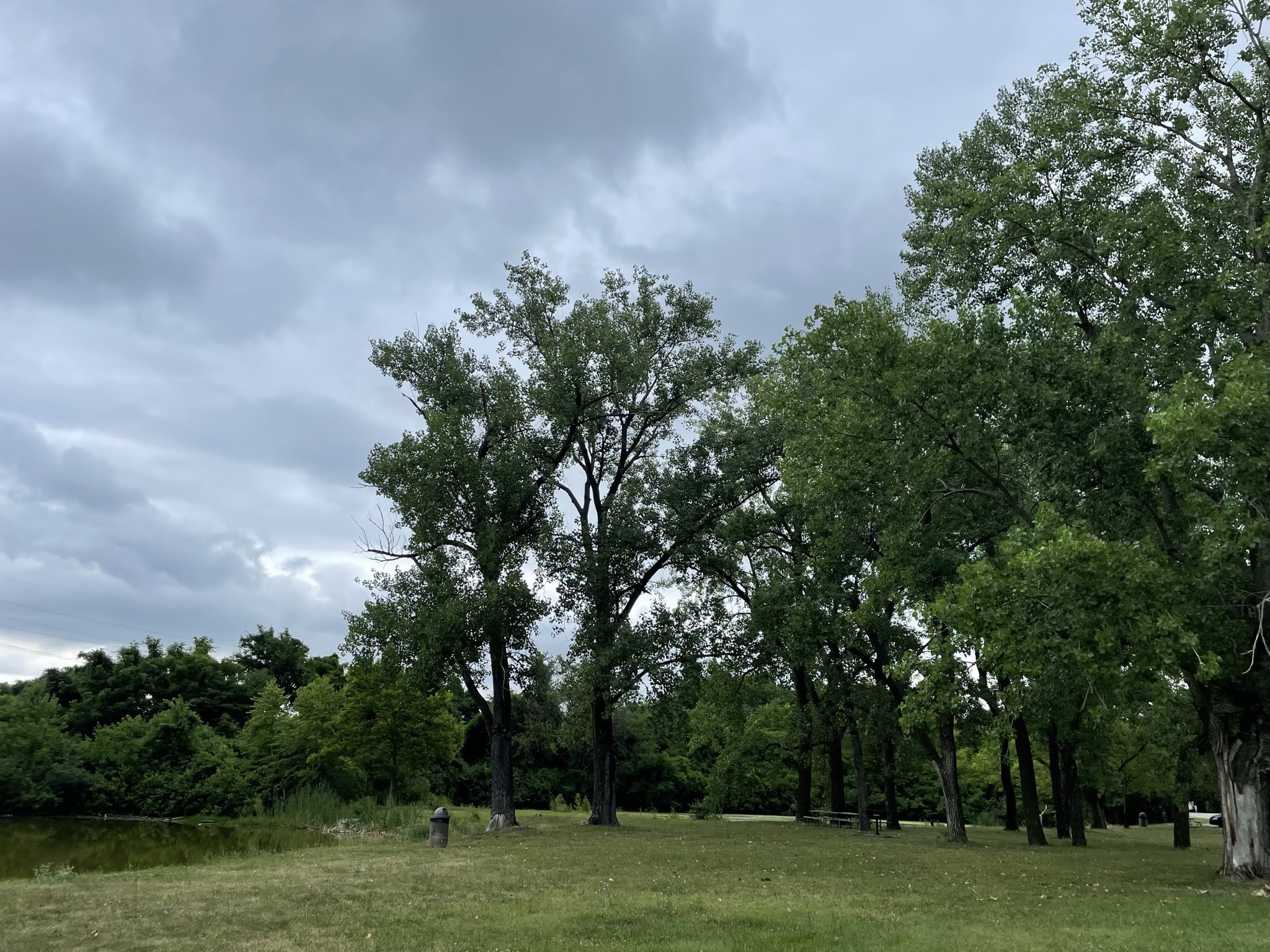
When conditions are perfect—that is, when the weather is cooperating, I have no obligations for the day, and I am experiencing an overabundance of executive function—I will find a park where I can go into the woods and be alone at a picnic table. I will bring a book to read and a notebook to write in. Last time I did this, I wrote Elephants Bury Their Dead.


Recently, I found a good spot on a lake in a state park.


 I can’t do couches or beds or coffee shops. I can’t do anything but sit upright someplace where my only company is myself and noise is limited. I find it uninteresting and rigid, much like my writing process itself, but I can’t say it doesn’t get shit done.